
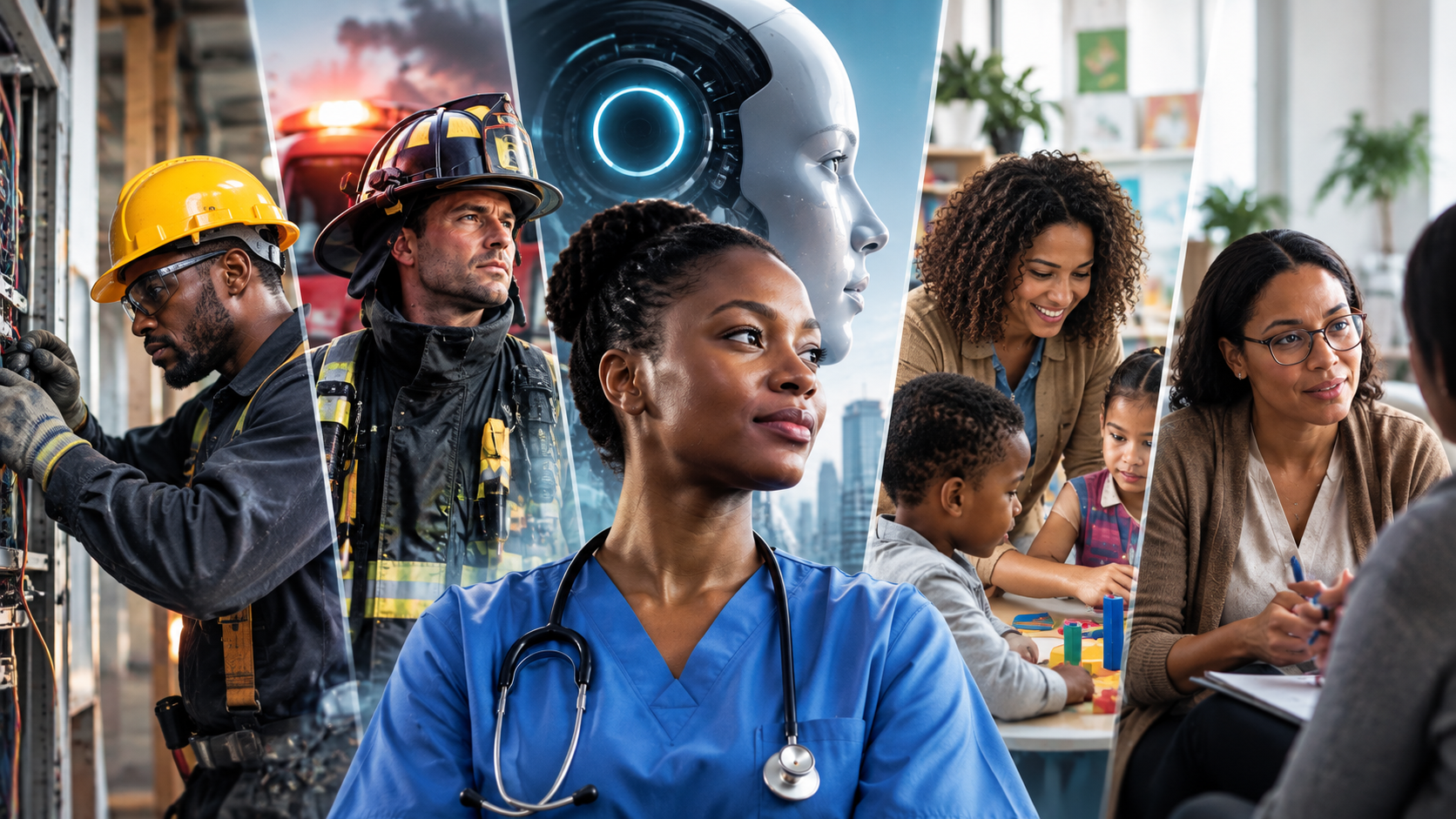
The question of what jobs AI can replace has become one of the biggest questions surrounding the future of work. Generative AI can already write documents, create images, summarize information, translate languages, generate software code and assist with research. AI systems are also becoming increasingly capable of working with voice, video and other forms of data.
But there is an important distinction between AI being able to perform some tasks within a job and AI being able to replace the entire job.
The International Labour Organization’s 2025 assessment found that about one in four workers globally are in occupations with some exposure to generative AI, but concluded that job transformation is more likely than complete replacement for most occupations because human input remains necessary. The OECD’s 2026 research similarly finds that current AI capabilities are closest to occupations involving routine information processing and codifiable tasks, while they are further from occupations requiring contextual judgment, interpersonal understanding, complex decision-making and responsibility.
So rather than asking which jobs are completely immune to AI, a more useful question is: which jobs contain important parts that are particularly difficult to automate?
- Nurses and Hands-On Healthcare Workers
Healthcare is already using AI for tasks such as medical documentation, image analysis, scheduling and decision support. That does not mean the nurse disappears.
A large part of nursing involves being physically present with another human being. A nurse may need to:
- Monitor a patient’s condition
- Administer treatment
- Assist with movement
- Respond to sudden changes
- Communicate with family members
- Comfort patients
- Coordinate with other healthcare professionals
- Make judgments in changing circumstances
Some of these activities can be supported by technology, but replacing the entire role requires much more than an AI system that can understand medical information. It requires physical interaction, contextual judgment and human communication.
The World Economic Forum’s Future of Jobs Report 2025 identifies care-economy roles, including nursing professionals, social workers and personal care aides, among the roles expected to grow significantly through 2030.
AI is therefore more likely to become part of a nurse’s toolkit than to eliminate the need for nurses altogether.
- Electricians, Plumbers and Other Skilled Trades
AI can increasingly help tradespeople with planning, diagnostics, documentation and design. But fixing a real building is still a physical activity.
An electrician may need to:
- Inspect an installation
- Trace a fault
- Access difficult spaces
- Handle tools
- Install components
- Adapt to an unexpected site condition
- Verify that the system works safely
A plumber faces similar conditions. No two buildings are necessarily identical, and real-world jobs often involve unexpected conditions that are difficult to represent completely in software.
This is one reason physical presence remains an important barrier to automation. However, skilled trades should not be described as AI-proof. The World Economic Forum’s 2025 research expects robotics and automation to transform many workplaces, while also identifying construction workers among the roles expected to experience significant growth in absolute numbers through 2030.
The important point is that the physical and unpredictable nature of trade work currently makes complete automation difficult. Improvements in robotics could change that over time.
- Emergency Responders
Firefighters, paramedics and other emergency responders work in environments where conditions can change from one moment to the next.
An emergency responder may have to:
- Assess a dangerous situation
- Communicate with people under stress
- Move through unpredictable environments
- Physically assist people
- Make decisions with incomplete information
- Coordinate with other responders
- Adapt when the original plan stops working
AI can assist these professionals. It can process information, analyze images, identify patterns and potentially help coordinate resources. But the physical execution of an emergency response is another matter.
A system can tell a responder that a building appears dangerous. Someone still has to enter the situation, interact with people and deal with what is actually happening.
The combination of physical presence, rapidly changing conditions and responsibility makes emergency response difficult to reduce to a purely digital workflow.
- Early Childhood Educators and Caregivers
Teaching is often discussed as a profession AI could disrupt, and AI can already explain concepts, generate exercises and provide personalized educational content.
But teaching young children involves much more than delivering information. Early childhood educators also help children develop:
- Communication
- Social skills
- Emotional regulation
- Cooperation
- Confidence
- Curiosity
- Independence
A teacher observes how children behave around one another, responds to conflicts and adjusts activities based on what is happening in the room. These interactions depend heavily on human relationships.
The World Economic Forum expects education roles, including secondary and tertiary teachers, to see significant growth through 2030. Its skills research also places empathy, active listening, leadership and social influence among important human capabilities alongside technological skills.
AI can become an educational tool without becoming the teacher. A classroom could increasingly look like teacher plus AI tools plus students, rather than teacher versus AI.
- Social Workers and Human-Centered Support Professionals
Some jobs depend heavily on understanding people in difficult circumstances. Social workers, counselors and related professionals may have to understand:
- A person’s circumstances
- Family relationships
- Social environment
- Cultural context
- Immediate risks
- Available support systems
- The person’s own priorities
The work also involves trust. A person dealing with a difficult situation may need someone who can listen, respond appropriately and take responsibility for decisions.
AI can assist with administrative work, information retrieval and documentation. It may also provide certain forms of conversational support. But an AI-generated response is not the same thing as a professional taking responsibility for a real person’s situation.
The ILO’s recent work on skills in the AI age emphasizes that AI adoption is increasing demand for cognitive, socioemotional, digital and AI skills, while adaptability, resilience and human agency remain important. - The Bigger Point: AI Usually Replaces Tasks Before It Replaces Jobs
Imagine a job containing ten major tasks. AI might automate three of them. That does not necessarily mean the job disappears. Instead, the worker may spend more time on the remaining seven.
This is consistent with the ILO’s finding that transformation is expected to be more common than outright replacement across most occupations exposed to generative AI.
The OECD makes a similar distinction, noting that AI affects employment through several channels: automation of existing tasks, creation of new tasks and occupations, and productivity improvements. The final employment effect depends on how these forces interact. - What Makes a Job Harder to Fully Automate?
Physical presence: The worker has to physically interact with the environment.
Human relationships: The job depends on trust, communication, empathy or social interaction.
Contextual judgment: The worker must interpret circumstances that cannot be completely specified in advance.
Responsibility: Someone must ultimately be accountable for decisions and their consequences.
Unpredictability: The environment changes and problems do not always follow a predefined pattern.
The OECD’s 2026 AI exposure research identifies contextual judgment, interpersonal understanding, complex decision-making and responsibility as areas where current AI capabilities are further from the requirements of occupations. - But No Job Should Be Called Completely AI-Proof
Technology changes. Robotics is improving. Computer vision is improving. AI systems are becoming better at working with voice, images and video. The boundary between digital and physical systems is also changing.
The World Economic Forum expects robotics and automation to be a major transformative force for businesses through 2030.
So saying that a particular profession can never be automated would go beyond what current evidence can establish. A better conclusion is that jobs combining human judgment, physical interaction, relationships and responsibility may be more difficult to automate completely, even when AI becomes deeply integrated into the work.
The Future May Be About Working With AI
The most realistic picture emerging from current research is not necessarily humans versus machines. It is increasingly humans working with machines.
The World Economic Forum identifies AI and big data as the fastest-growing skills in its 2025 employer survey, while creative thinking, resilience, flexibility, curiosity, leadership and social influence also remain important.
The OECD’s 2026 research similarly finds that AI is increasing the importance of skills such as data interpretation, problem-solving, creativity and innovation in many workplaces.
That means the valuable worker of the future may not be someone who avoids AI. It may be someone who knows where AI is useful, where human judgment is needed, and how to combine the two effectively.
The Takeaway
There are no reliable guarantees that any occupation will remain completely untouched by AI.
But current evidence suggests that jobs involving physical presence, interpersonal relationships, contextual judgment, complex decision-making and responsibility present greater challenges for complete automation than routine, codifiable information-processing work.
For workers, that changes the question. Instead of asking, ‘What job will AI never touch?’ a more useful question may be, ‘What human capabilities will remain valuable as AI becomes more capable?’
Leave a Reply