
How much synthetic data do you need for YOLO?

One of the first questions teams ask when considering synthetic data for YOLO object detection is deceptively simple: How many synthetic images do I need?
There is no scientifically valid number that works for every YOLO project.
The amount of synthetic data required depends on the objects being detected, the number of classes, the variation in the real environment, the quality of the synthetic images, the diversity of viewpoints and backgrounds, and how closely the synthetic data represents the conditions in which the model will eventually operate.
In other words, more synthetic images do not automatically mean a better YOLO model.
There Is No Universal Synthetic-Data Ratio
Ultralytics’ guidance for YOLOv5 historically recommends at least 1,500 images per class and 10,000 labeled instances per class as a general dataset target. However, the same guidance emphasizes that images should be representative of the deployment environment, including variation in lighting, weather, viewpoints, cameras and other conditions.
Those numbers should therefore not be interpreted as saying that every YOLO model needs exactly 1,500 synthetic images per class. They are general training guidance, not a rule for synthetic datasets. Synthetic-data requirements are particularly dependent on how well the generated images cover the situations the model will encounter.
For example, generating thousands of nearly identical renders of an object from the same camera angle may add far less useful information than generating a smaller but carefully designed dataset containing different viewpoints, scales, lighting conditions, backgrounds and object configurations.
Diversity Can Matter More Than Raw Image Count
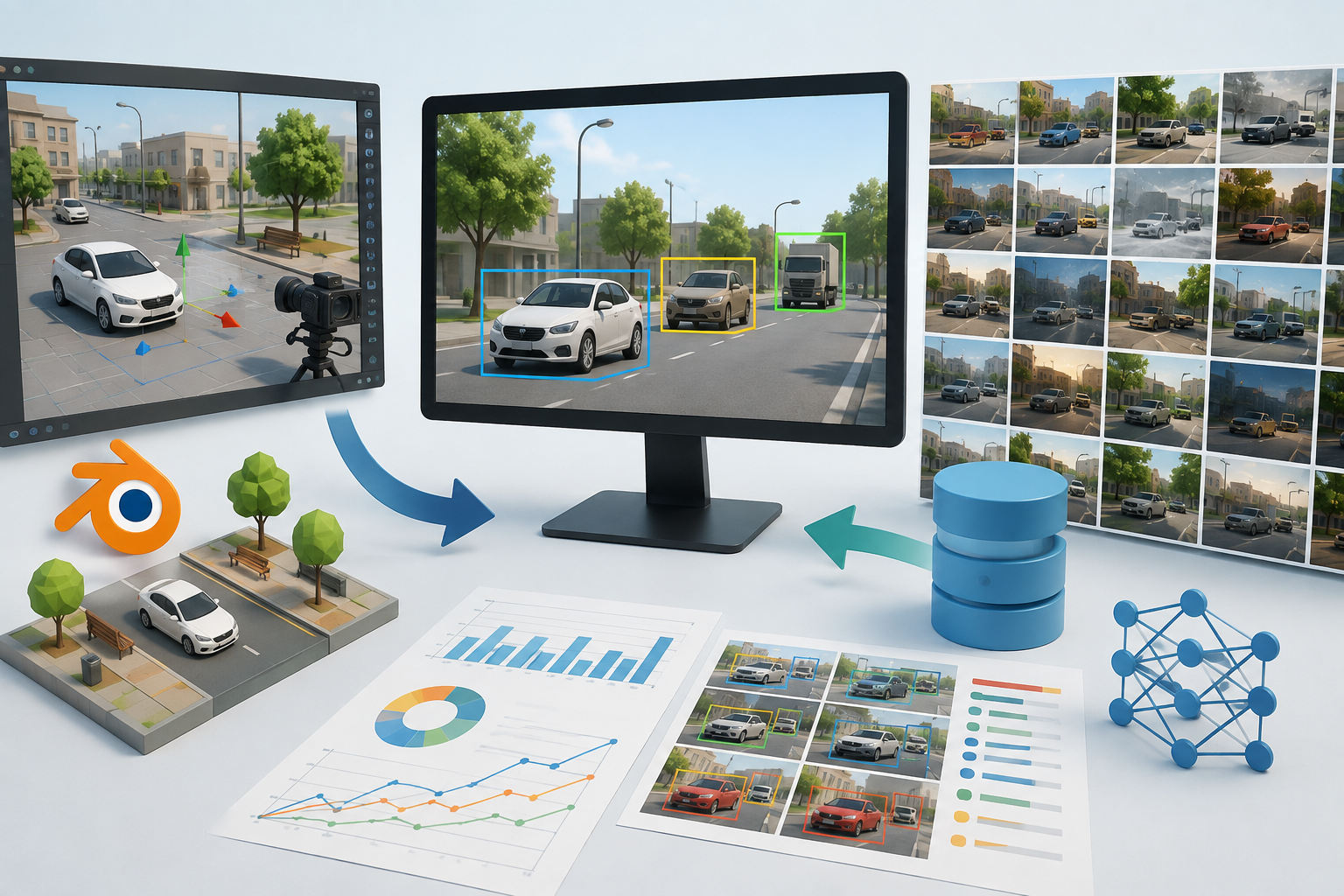
A major advantage of synthetic data is that the generation process can deliberately introduce variation. A Blender-based synthetic-data pipeline, for example, can vary camera position, object position, lighting, materials and backgrounds while automatically producing annotations. A publicly documented research project from Brno University of Technology uses Blender-generated synthetic images alongside real images and compares different dataset compositions for object detection. This makes synthetic data particularly useful when the real-world dataset does not adequately cover important conditions.
The goal should therefore be to ask:
How many different situations does my model need to learn? rather than simply:
“How many images should I generate?”
Synthetic Data Can Work, but Real-World Validation Is Essential
Research on synthetic-to-real YOLO training demonstrates why this distinction matters.
A 2025 study investigated YOLOv11 training using synthetic images and domain-randomization strategies for detecting a specific object. The researchers found that synthetic validation results could be high while still being poor predictors of performance on real-world images. They therefore evaluated the trained models against a manually labeled real-world test set. Their experiments also found that increasing synthetic diversity, including different viewpoints and more complex backgrounds, was important for reducing the synthetic-to-real gap. This leads to an important practical rule:
Do not decide that your synthetic dataset is sufficient simply because YOLO performs well on synthetic validation images.
The real test is whether the model performs well on representative data from the environment where it will be deployed.
Should You Use Only Synthetic Data?
Sometimes synthetic-only training can work, but it should not be assumed to be the best strategy. Synthetic data is especially attractive when collecting and labeling real examples is expensive, difficult or impossible. It also makes it possible to deliberately create examples of particular conditions that may be rare in existing datasets.
However, the real world contains variations that are difficult to reproduce perfectly in a simulation. Differences in camera characteristics, lighting, backgrounds, object appearance and unexpected situations can create a domain gap between synthetic and real images. This is one reason synthetic data is often used alongside real data rather than treated automatically as a complete replacement.
So, How Much Should You Generate?
A better approach is to start with an experimental dataset rather than choosing an arbitrary final number. Create a representative synthetic dataset, train the YOLO model, and evaluate it against a separate real-world validation or test set. Then investigate the errors.
If the model struggles with particular viewpoints, lighting conditions, object sizes, backgrounds or object configurations, generate additional synthetic examples specifically targeting those weaknesses. This creates an iterative process:
Generate > Train > Evaluate on real data > Analyze errors > Generate targeted data > Retrain.
That is more defensible than deciding in advance that a project needs 10,000, 50,000 or 1 million synthetic images.
The Bottom Line
There is no universal number of synthetic images that YOLO needs. The useful quantity is the amount of relevant and diverse training information required for your particular detection problem.
A smaller synthetic dataset with strong variation can be more useful than a much larger dataset containing repetitive scenes. Conversely, a difficult production environment may require substantially more data and experimentation.
For a serious computer-vision project, the safest strategy is therefore to establish a baseline, evaluate against representative real-world data, identify weaknesses, and use synthetic generation to deliberately fill those gaps.
The question isn’t really:
“How much synthetic data does YOLO need?”
It is:
How much diverse, relevant data does this detection problem require to perform reliably in the real world?
That is the question your experiments should answer
Leave a Reply